PROCESS
READ 06 MIN
When someone comes to me for a new brand, it would be easy to start with the things we can see.
A logo. Colours. Typography. Maybe a moodboard.
And I understand why we are naturally drawn to that part. It is exciting. It is the moment when an idea starts becoming something tangible.
But I don’t like to begin there.
Before I think about what a brand should look like, I need to understand what I am actually designing for.
I want to know the person behind the business. What they are building, why it matters to them, who they want to reach and where they want to go.
Sometimes those answers are very clear from the beginning.
Sometimes they aren’t.
And that is completely normal.
A client might know that something no longer feels right, but not yet know what needs to change. They might have a very clear vision for their business but struggle to express it visually. Or they may simply know that they have outgrown what they currently have.
For me, that is where the real work begins.
I want to understand what is underneath
Before we talk about fonts or colours, I want to understand the business beyond what it sells.
What do you want people to remember about you?
What should working with you feel like?
What do you want to be known for?
What feels genuinely yours — and what have you perhaps adopted simply because it is common in your industry?
These conversations often reveal much more than a moodboard ever could.
And sometimes they reveal things the client had not consciously put into words before.
That is one of my favourite parts of the process.
There is usually a point where scattered ideas begin to connect. Something that initially felt difficult to explain suddenly becomes much simpler.
We begin to see what matters — and also what doesn’t.
That clarity gives me a foundation to design from.
It makes visual decisions easier
Without a clear direction, almost every design decision becomes a matter of personal preference.
Do we like this colour?
Is this font elegant enough?
Should the logo be more minimal?
Would something softer look better?
There could be dozens of perfectly beautiful answers.
But beautiful is not enough for me.
I want to know whether a decision makes sense for this particular brand.
Once I understand the direction, the visual process becomes much more focused.
I’m not choosing a typeface simply because I like it. I’m looking at whether its character reflects the business.
I’m not building a colour palette around what happens to be popular at the moment. I’m thinking about the atmosphere we want to create and whether those colours can continue to feel right several years from now.
And I’m not trying to make a logo carry the entire identity on its own.
It becomes one part of something much larger.
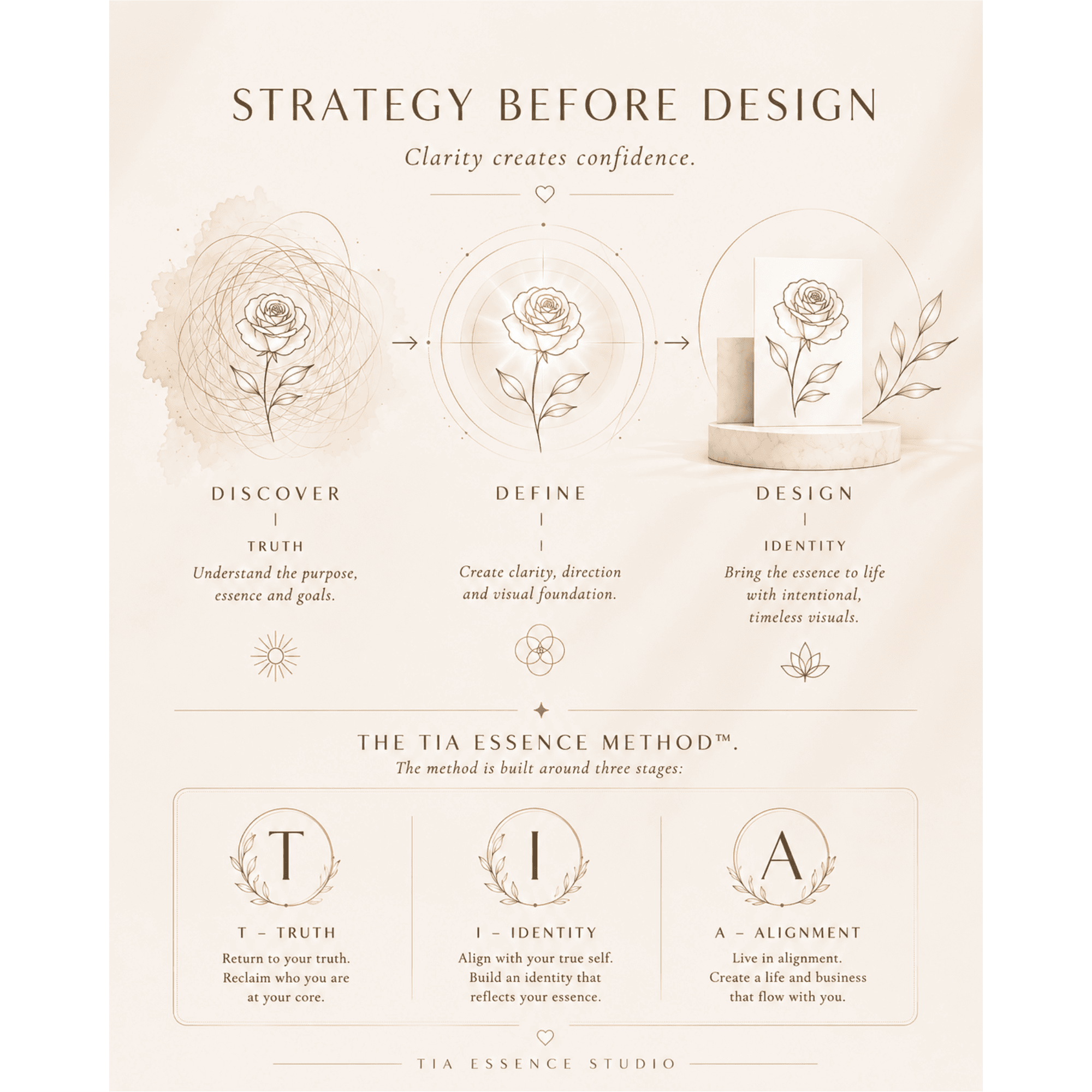
Discover. Define. Design.
This is why I think about the process in three broad stages.
Discover is where I listen and ask questions.
I want to understand the truth of the business — its purpose, its ambitions, its audience and the person behind it.
Define is where we begin making sense of what we have discovered.
Not everything needs to become part of the brand. We look for what is essential, what differentiates it and what direction feels both authentic and useful.
Only then do we move into Design.
This is where the thinking begins to take visual form.
Typography, colour, composition, imagery and the logo start working together to express what we have already discovered.
Of course, real projects are rarely as perfectly linear as three neat stages on a page.
Sometimes something I explore visually makes me return to an earlier question.
Sometimes a conversation changes the direction.
Sometimes the first idea leads somewhere unexpected.
I actually think that is a healthy part of the process.
The framework gives us direction, but there still needs to be room to discover.
I’m not looking for a brand that simply looks good
What I really want is that moment when everything starts to belong together.
The words feel connected to the visuals.
The typography feels natural rather than selected.
The colours create the right atmosphere.
The logo no longer feels like something placed on top of the business.
It feels like it belongs to it.
And when that happens, the client usually feels it too.
There is less explaining.
Less second-guessing.
Less asking whether we should try another direction simply because another direction is possible.
There is a sense of recognition.
“Yes. This feels like us.”
That matters to me much more than creating something that is simply beautiful.
Because a brand eventually has to live far beyond the design presentation.
It needs to work on a website, in an email, in a proposal, on social media and in conversations with clients.
It needs to give the person behind the business enough clarity to continue using it confidently when I am no longer there making every decision.
That is why I prefer to spend time understanding before I start designing.
Not to make the process more complicated.
Quite the opposite.
The better I understand what we are trying to express, the less we need to rely on guesswork.
And that is usually where the strongest design begins.